I PUSHED MY WAY IN
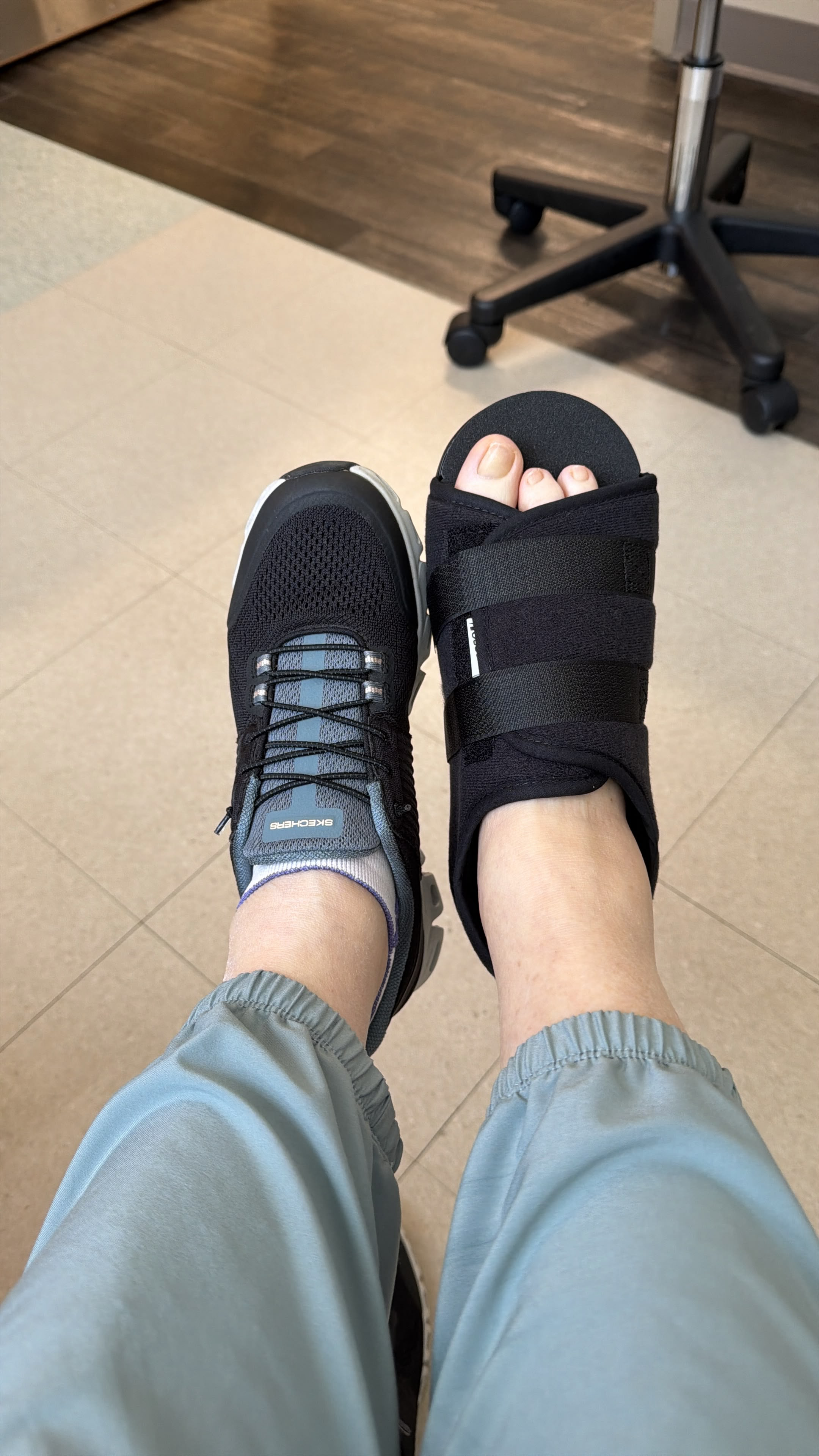
I have a stress fracture.* I lived with high arches for 73 years before they caused a problem.
I walked in sandals and hurt the bone on the side of my foot, which caused me to compensate for that pain, resulting in a stress fracture at the spot where my second toe connects to my foot. It’s the “always something” category.
It all started seven weeks before I had an MRI, which led to the proper diagnosis. It’s not like I didn’t try to get to the root of the problem. As usual, a lot was going on, but I did “doctor up.”
Around the same time, I had a lingering sore throat and cough, which turned out to be mild bronchitis. After a visit to Urgent Care and two visits to an ear, nose, and throat doctor (ENT), I saw my primary care provider (PCP).
The ENT said it was a weird virus that he also had and would last 3 1/2 to 4 weeks. Then, I went to the PCP, and he diagnosed mild bronchitis. I asked about my foot pain in the bone on the right side of my right foot, and he said it’s not his area of expertise. I said, “See the foot doctor?” He shook his head yes, but didn’t say to see the orthopedist across the street who specializes in foot and ankle issues.
I made the earliest appointment that week to see the podiatrist. He said it was probably from a gym exercise and to rub Biofreeze on it and take over-the-counter medications as needed. That didn’t help, and over the next few weeks, as the pain in the bone on the side of my foot stopped bothering me, the pain seemed to spread to the base of my toes.
Ten days later, I returned to the foot doctor for reevaluation. That time he took two X-rays. He diagnosed possible gout because, he said, I had the four symptoms of gout, even though gout usually manifests in a major joint, such as the big toe. He prescribed a gout medication for two weeks and said to take Advil to reduce any swelling.
The very next day, I went to the vascular surgeon I had seen in the summer after my tremendously painful hematoma set in on the same leg. See Calling 888 Rapid Response Team, dated September 8, 2026, at sharonmarkcohen.com. I needed to make sure my foot pain was unrelated to my leg issue, and he assured me that it was.
Later that afternoon, my husband asked if I wanted to go for a walk. I told him that the back of my calf started to hurt and I didn’t want to call the vascular surgeon back for fear he would think I was being a hypochondriac. Was the new calf pain due to overcompensating for the foot pain?
Three days after seeing the foot doctor for the second time, and two days after getting reassurance from the vascular surgeon, my husband and I flew to Cleveland to celebrate our grandson’s second birthday. It was the first time we’ve flown in 11 months, since before my husband had back surgery with major complications. All the doctors I’ve seen over the last several months assured me it was safe to fly.
While in Cleveland, whenever I walked, the pain in my foot became unbearable. I called the foot doctor in New Jersey, and he advised me to increase my dosage of Advil.
At the end of our conversation, he said, “But you have no pain in the calf, right?” I said, "I do have pain in the calf when I walk,” and he said, “Then have a venous Doppler before you get back on the plane.” Hearing that, my son drove me to two Urgent Care facilities, but neither was equipped to do Doppler testing. I ended up in the Cleveland Clinic emergency department (CCED).
The Doppler showed a superficial thrombophlebitis of the small saphenous vein. The doctors at CCED said they were going to treat me conservatively with no medication. They wrote in the discharge papers, “Strict return precautions were thoroughly discussed,” emphasizing that before flying again, a repeat Doppler was needed within 72 hours.
We canceled our plans to fly to D.C. the next day, and stayed at our son’s house. We arranged for the repeat Doppler, which showed the clot was maybe slightly smaller. I was told to take a baby aspirin and wear compression stockings, which, as advised by my wound specialist who treated my leg after the hematoma, I wore when flying to Cleveland.
We took the one-hour flight home from Cleveland on a Sunday. On Monday, I visited the foot doctor with a freshly baked cake I made for him in appreciation for saving my life by telling me to check for a blood clot before flying. At that visit, he told me my diagnosis is not gout, and he doesn’t know what’s wrong with my foot. He cautioned me to continue taking the Advil to keep the swelling down, or risk having permanent pain in the toe, and to return in two weeks.
After speaking with a family member who practices Pain Management, I decided on an Advil/Tylenol combo. The next day, I saw my PCP for a post-hospital visit, and he said I was fine and did not even need to take baby aspirin when I fly next time. But if I have more calf pain, he cautioned, I should see the vascular surgeon I had seen before. He said he would recommend a second opinion on my foot pain and to see the orthopedist across the street who specializes in foot and ankle issues.
I made an appointment to see the orthopedist six days later. First, they took three X-rays. When the doctor walked in, he took one look at my foot and said, “I know what the problem is.” He could tell from my high arches.
The X-rays were negative, so the doctor ordered an MRI “stat.” When he heard we would be flying again the next week, he also told me to see the vascular surgeon. He had his assistant fit me with a hard-soled shoe to wear and told me to take over-the-counter pain medications as needed. He said he didn’t agree that not taking Advil to reduce the swelling would lead to permanent joint pain.
After the doctor left the exam room, I stayed and called to schedule my MRI appointment. I continued and made an appointment to see the vascular surgeon before going to the desk to schedule my follow-up with the orthopedist.
Then I sent a WhatsApp message to our children to let them know what I said and did to get squeezed in for the appointments. Our younger son commented, “So everything in the next two days then?” I said, “Yep.”
Justifiably, I forced my way in for the three appointments. When I said we’re scheduled to go to California next week, the orthopedist sent for the MRI “stat.” When I called to make the appointment, I waited online for about 10 minutes until someone picked up. I told him I needed the MRI right away and that the doctor said “stat.” He booked me for the next day at 3:00 pm.
Next, I called the vascular surgeon’s office. They wanted to schedule an appointment for the following Tuesday. I politely asked, “Can I do it this week?” The receptionist said he’s only in on Tuesdays. Since it was a Monday, I politely but forcefully asked, “Can you squeeze me in tomorrow?” I continued by saying I was at the CCED and had been given the diagnosis of a blood clot.
After checking, she came right back and said, “Okay, can you come in at 12:30 tomorrow?” The times worked perfectly. They worked even better when I received a call the next day asking if I could come in at 1:30 for the MRI. The two offices were a seven-minute drive apart.
With those two appointments booked, I headed to the desk at the orthopedist’s office to arrange a follow-up appointment. The first appointment they offered was for the following Monday. Instead, I asked if I could come back this week.
The receptionist said we want to make sure your reports from the MRI are back. She asked if they were ordered “stat,” and I said, “Yes.” She checked and said. “Oh yeah, OK, can you come Wednesday morning at 8:45? I quickly said yes.
When I got back to the orthopedist’s office on Wednesday morning, his first comment was, “Good job! How did you get this all done so fast?” Smiling, I said, “I pushed my way in.” He loved it.
He said the problem with my foot is what he thought: a stress fracture of the second digit. He said he won’t put me in a boot because of the blood clot in my leg. I’m to wear the hard-soled shoe for a month and come back.
If my foot still hurts, the doctor said he’ll have me wear the hard-soled shoe for another two weeks. The doctor explained that the stress fracture was probably caused by me taking the pressure off where I hurt the side of my foot while walking in the sandals.
When I looked at the after-visit summary on MyChart, it said WBAT in HSS. I had to rely on the internet to figure that out…”weight-bearing as tolerated in hard-soled shoe.”
With the blood clot, the protocol is to walk. The stress fracture heals with rest and limited weight-bearing. What’s a girl to do? Push my way through.
~~~~~~~~~~~~~~~~~~~~~~~~~~~~~~~~~~~~~~~~~~~~~~~~~~~~~~~~~~~~~~~~~~~~~~~~~~~~~~~~
*MRI findings are most compatible with a subchondral fracture with acute marrow edema of the second metatarsal head. No osseous fragmentation.