A JEWISH MUSEUM IN ALASKA? WHO KNEW?

ICYMI, copied here is my published article from the September 25, 2025 issue of the Jewish Link newspaper, where I am a staff writer:
Alaska became our 49th state in 1959. The news of a new state in the union was a hot topic when I was in kindergarten. Fond memories from grammar school surface now and then—of studying about Eskimos, igloos, whale blubber, dog sleds and totem poles. That course of study left me with a burning desire to visit the largest state in the country.
As a gift to ourselves for our 50th wedding anniversary on June 15, my husband and I turned that dream into a reality. Having now visited all 50 states, some would argue we saved the best for last. When meeting friendly locals in “The Last Frontier,” whenever we told our story of “50 for 50,” eyes lit up, and there were even some tears.
On our 10-day trip, aside from visiting many welcome centers and museums displaying interesting native heritage items, we found the Anchorage Jewish Museum (AJM) to be a gem. The midtown Anchorage single-floor building is next to the large Alaska Jewish Campus. The well-curated AJM makes good use of the limited wall and floor space to highlight all aspects of Jewish life in the 49th state.
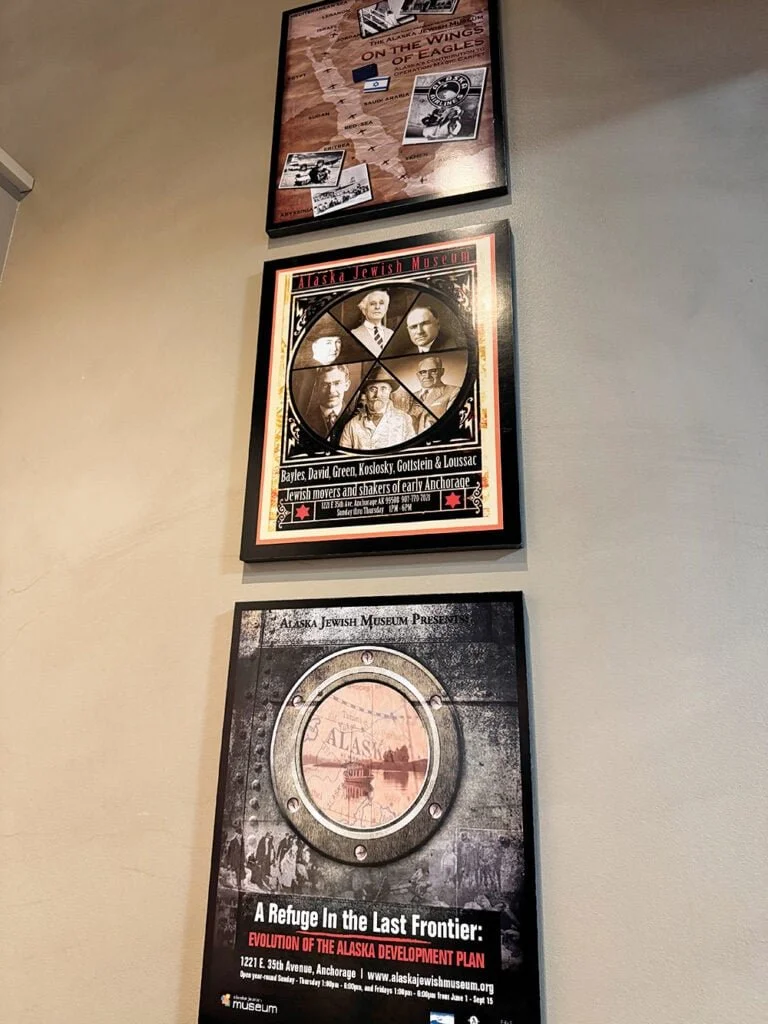
Plaques on wall of AJM.
AJM, launched in 2013, was the brainchild of a board led by Rabbi Yosef Greenberg. A shaliach who has made Anchorage his home for 35 years, Rabbi Greenberg recruited Leslie Fried to be the curator. And the rest, as they say, is history … in this case, the history of the Jewish influence in Alaska.
Born in Israel and raised on Long Island, Fried spent 27 years living in Seattle before being recruited by Rabbi Greenberg. The masterfully curated AJM was voted by the Anchorage Press as one of the three best museums in Anchorage, along with the Anchorage Museum and the Alaska Native Heritage Museum. We would vote for all three as well.
Fried’s business card touts “Alaska Jewish Museum—A home for Jewish history, art and culture in Alaska.” As curator, she wants “to share with the visitor items that explore the history and horrors of antisemitism, the power of art to teach, and the resiliency of the Jewish community.”
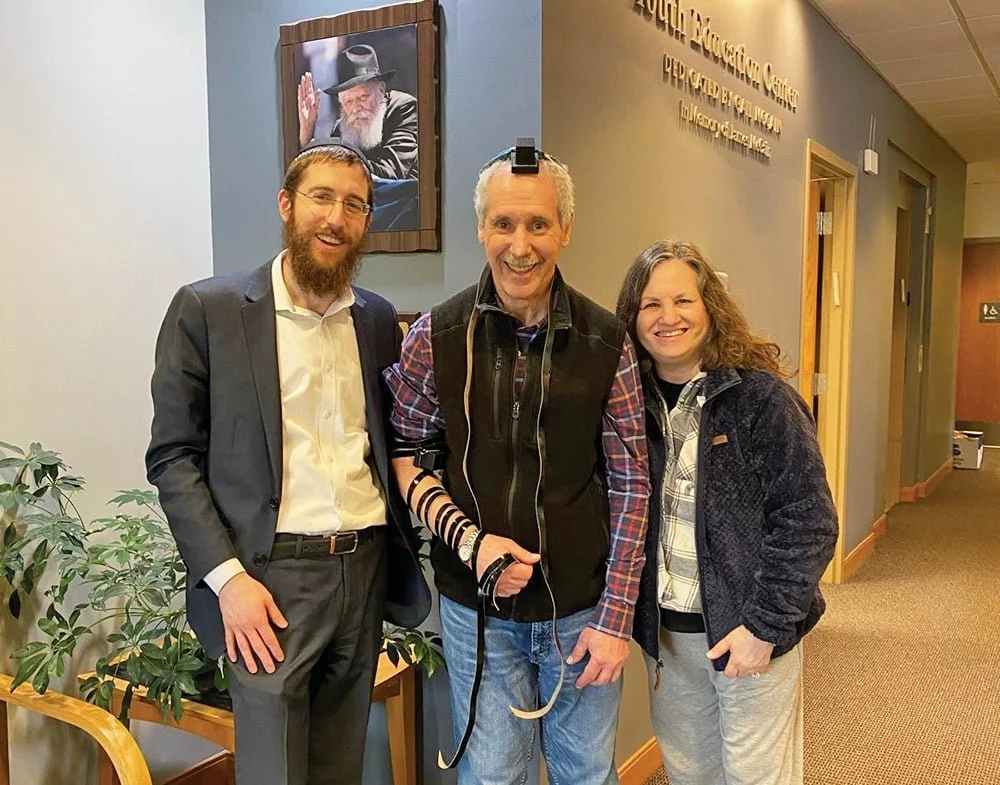
Rabbi Levi Glitsenstein, Arnee Cohen donning tefillin, the author, Alaska Jewish Campus, Anchorage.
The museum’s vision statement declares: “The Alaska Jewish Museum (AJM) tells the stories of Alaska’s Jewish residents and their contributions to the State of Alaska and provides a gathering place and historical repository to promote diversity and tolerance for all Alaskans.” Using exhibits and programming to “enrich the cultural wealth of the broader Alaskan community,” AJM “demonstrates the living connections between the past and the present.” Its archival collection “tells the story of the Jewish experience in Alaska.”
A Jewish presence in Alaska began in the 1800s with fur traders from Russia, joined by gold miners from San Francisco. Eventually, Alaska became home to Jewish merchants, military personnel and politicians. About 6,500 Jews live in Alaska, the majority residing in the most populated cities, Anchorage, Fairbanks and Juneau.
There are three Chabad Lubavitch Centers in Alaska. The Alaska Jewish Campus, in Anchorage, is headed by Rabbi Yosef and Esty Greenberg. Mat-Su Jewish Center, in Palmer, a 45-minute drive from Anchorage, is headed by a son of the Greenbergs, Rabbi Mendy, with his wife, Chaya. Rabbi Heshy Wolf and his wife, Chani, established Fairbanks Jewish Center, the northernmost Chabad House in the world.
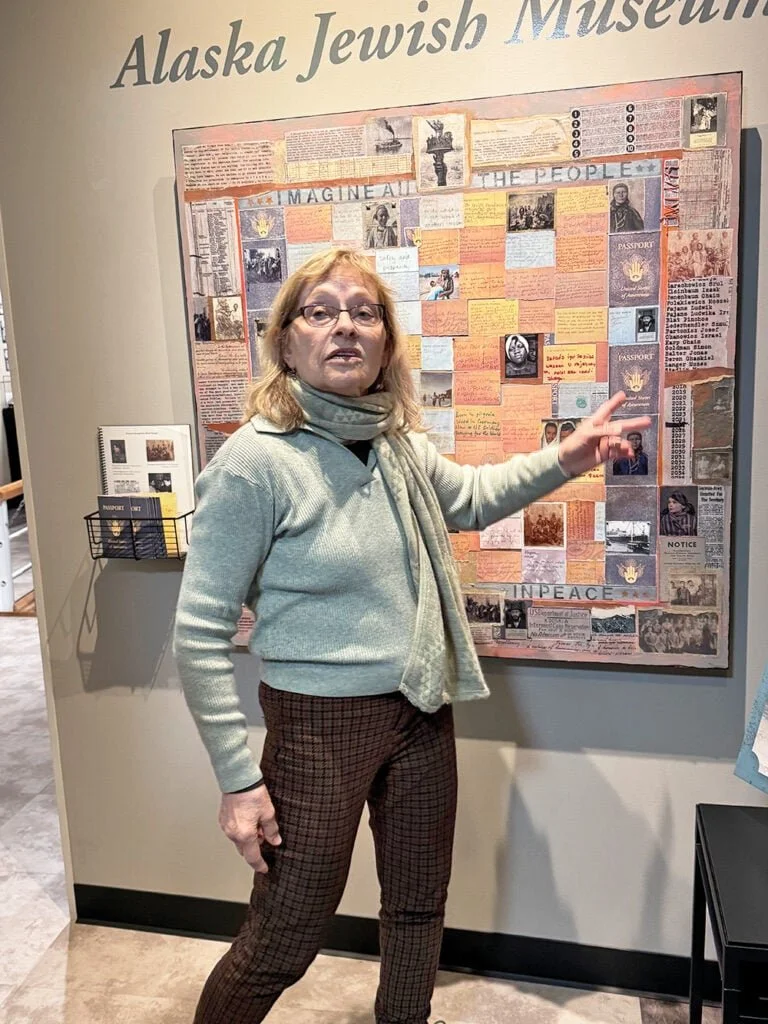
Leslie Fried, AJM curator.
Beth Sholom is a Reform synagogue in Anchorage. Congregation Sukkat Shalom is the Reform synagogue in Juneau.
Kosher-certified packaged items can be found in supermarkets, just as in any large market in the Lower 48. By ordering in advance, meals can be purchased for Shabbat at Anchorage Chabad. Seattle Kosher ships to Chabad for easy pickup. A mikvah is located a five-minute walk from the Anchorage campus.
During the busy tourist season, an open recorder shows visitors signed in from states throughout the U.S. and numerous countries around the globe. At AJM, school groups, cruise ship passengers and individual guests learn about the state’s diverse history. The lessons include the influence of Alaska’s Jewish population.
An announcement in AJM’s current newsletter states: “Many are surprised to find out that there is not only a Jewish Museum in Alaska, but that the history of the Jewish people of Alaska goes back to at least the mid-1800s.” “Ruth Gruber: Photojournalist,” hosted by the Anchorage Museum, was the first exhibit AJM sponsored when it opened in 2013.
A visit to AJM topped our list for our first day in Alaska. Although it only takes 15 minutes to walk through the exhibits, video screens and audio clips enhance the experience.
While touring the museum with the curator as the docent, we were joined by a family from Texas, visiting while in Alaska to attend a wedding. We engaged in conversation and snapped photos to look at later, rather than taking the time to read the voluminous amount of information. Reviewing the postings captured in pictures was time well spent at leisure.
The literature at AJM includes the history of Jewish family members who made Alaska their home. Some, such as Beverly (Bev) Churchill, are the fourth generation in their families to have lived in Alaska. Churchill’s story is recorded on the AJM website under “Conversations With the Curator.”
AJM’s well-stocked gift shop has the perfect selection of original Alaskan kippot. A beautifully colored kippah depicting Alaskan wildlife was a welcome gift for our grandson’s fifth birthday. Fried asked us to send her a picture of him wearing his Alaskan kippah. He now appears modeling it on the AJM website.

Dizzy Cohen models an Alaska kippah
After visiting the museum, we were encouraged to meet the Chabad rabbis next door to learn about their history in “The Last Frontier,” and their thriving programs, including school and camp.
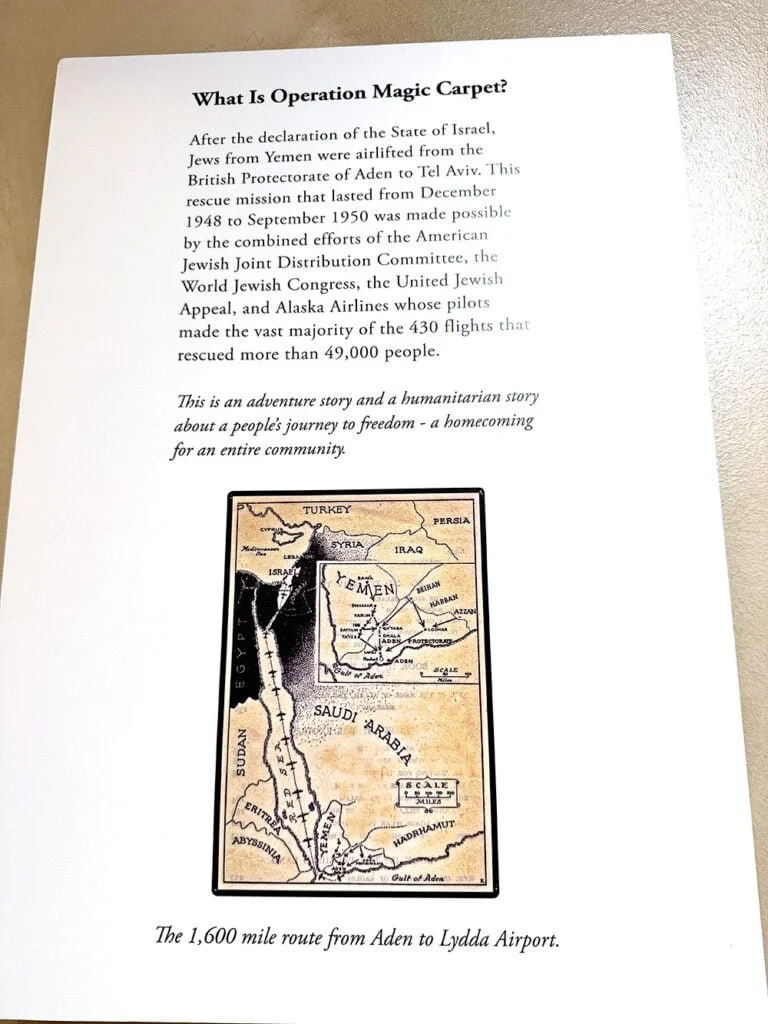
Operation Magic Carpet explained on the wall of AJM
When we arrived home, we found a suggestion to view the Facebook page of Rabbi Levi Glitsenstein, the associate rabbi at the Alaska Jewish Campus. A picture appeared of my husband donning tefillin, flanked by Rabbi Glitsenstein and me.
Over our 10 days enjoying Anchorage, Palmer, Homer, Seward and Denali, the seasonal daytime temperatures ranged from the mid-60s to the low 80s. Nighttime temperatures were high 40s to low 50s. By mid-June, the busy season was widely anticipated, with an increased number of workers and tourists expected for the summer, when the sun never fully sets.
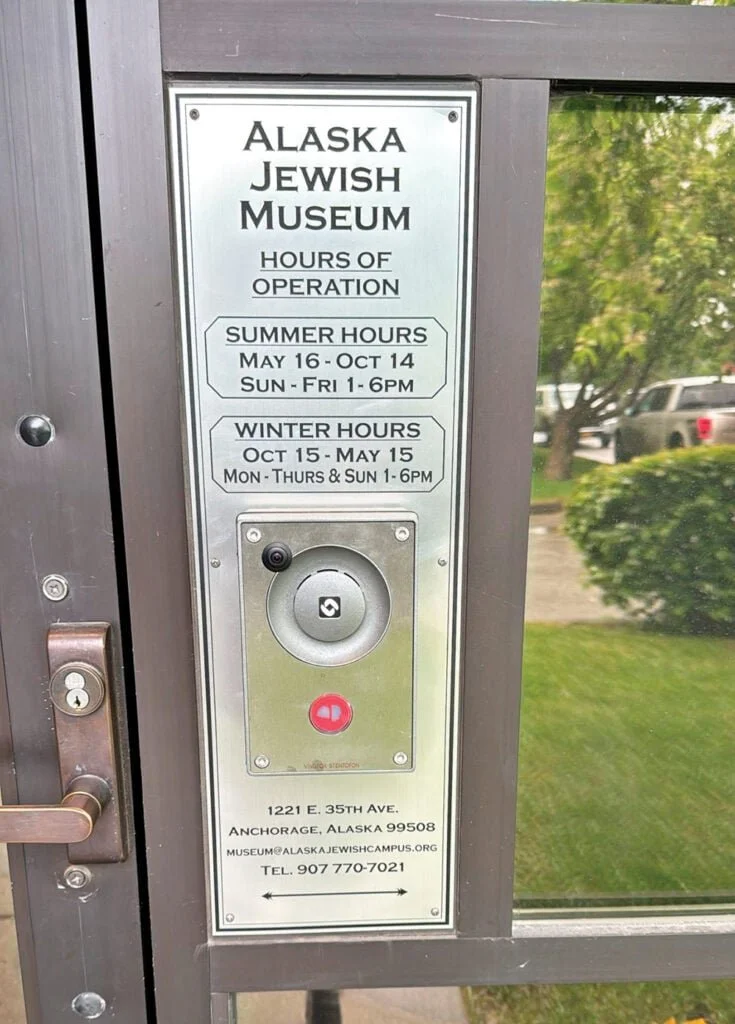
To learn more about AJM, visit alaskajewishmuseum.com.
Groups of six or more must call to preregister at 907-538-4420.
Sharon Mark Cohen believes everyone deserves a legacy. Follow her at sharonmarkcohen.com.